
by Joel B Kyndiah & Kishwar Jahan Chowdhury
Why Youth, Why the Barak-Meghna Basin?
When a river rises in the hills of Northeast India, or when a wetland in Sylhet, Bangladesh, dries earlier than expected, its effects ripples. A decision made upstream about land use, can reshape fisheries downstream.
In the Barak–Meghna Basin, an area of 82,000km², linking India and Bangladesh, this is an everyday truth. What affects the Barak’s flow in India’s Manipur and Assam states can soon become pressure on the Surma and Kushiyara rivers in Bangladesh.
Agricultural runoff, plastic waste entering drains and canals, and rising sediment loads do not remain localised within borders. They travel, and in doing so, the river system itself reminds us that caring for water in one place means caring for it everywhere.
This is also why youth across the Barak-Meghna Basin began working together to better understand these changes, and to support communities who call the Basin home, and to support the institutions responding to these changes.
For us — Joel, a final year law student from upstream Meghalaya in India, and Kishwar, a young assistant professor in environmental science, from downstream Chittagong in Bangladesh, this pathway began when we joined the Youth for Meghna (Y4M) Network in 2023, under IUCN’s youth strategy within the Meghna Water Futures Programme (2023-2026) – supported by IUCN’s BRIDGE Programme and Valuing Water Initiative as well as Oxfam’s TROSA 2 Programme.
Y4M brought together 18 early-career professionals from Bangladesh and India working in ecology, economics, GIS, law, and other fields, to support IUCN and communities in Barak-Meghna, through youth dialogue, research, field studies, and youth-led basin-level actions addressing water challenges.
Our work in the Basin moves along like three converging tributaries – (1) strengthening water law and governance, (2) designing NbS strategies rooted in place, and (3) advancing research and fellowship that carries lived insights forward.
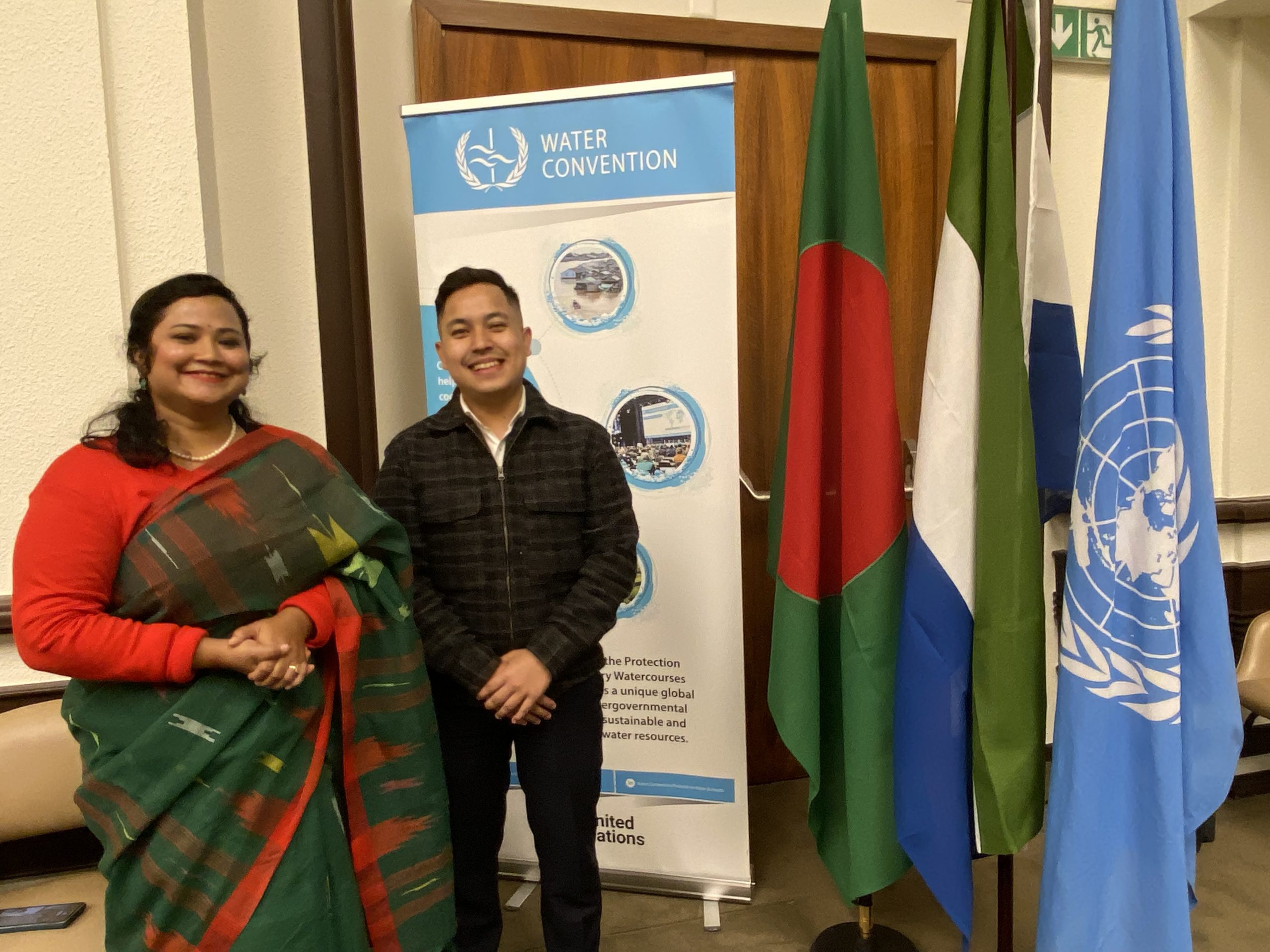
Joel B Kyndiah and Kishwar Jahan Chowdhury representing the Youth For Meghna | Geneva, October 2025
What are we learning from the Barak-Meghna Basin?
It was this journey through Y4M, that brought us to the Palais Des Nations, at the United Nations Economic Commission for Europe (UNECE) Secretariat, in Geneva, in October 2025, as delegates for the 6th Joint Meeting on Integrated Water Resources Management (IWRM) and Monitoring and Assessment, amongst diplomats, government representatives, and international organisations engaged in advancing cooperative governance of shared waters.
Over the course of three days, from October 13 – 15, we listened to discussions that flowed from source-to-sea linkages to strengthening ecosystem restoration, climate resilience, and the exchange of monitoring information. All of which reminded us that what happens in one part of a river system inevitably shapes another.
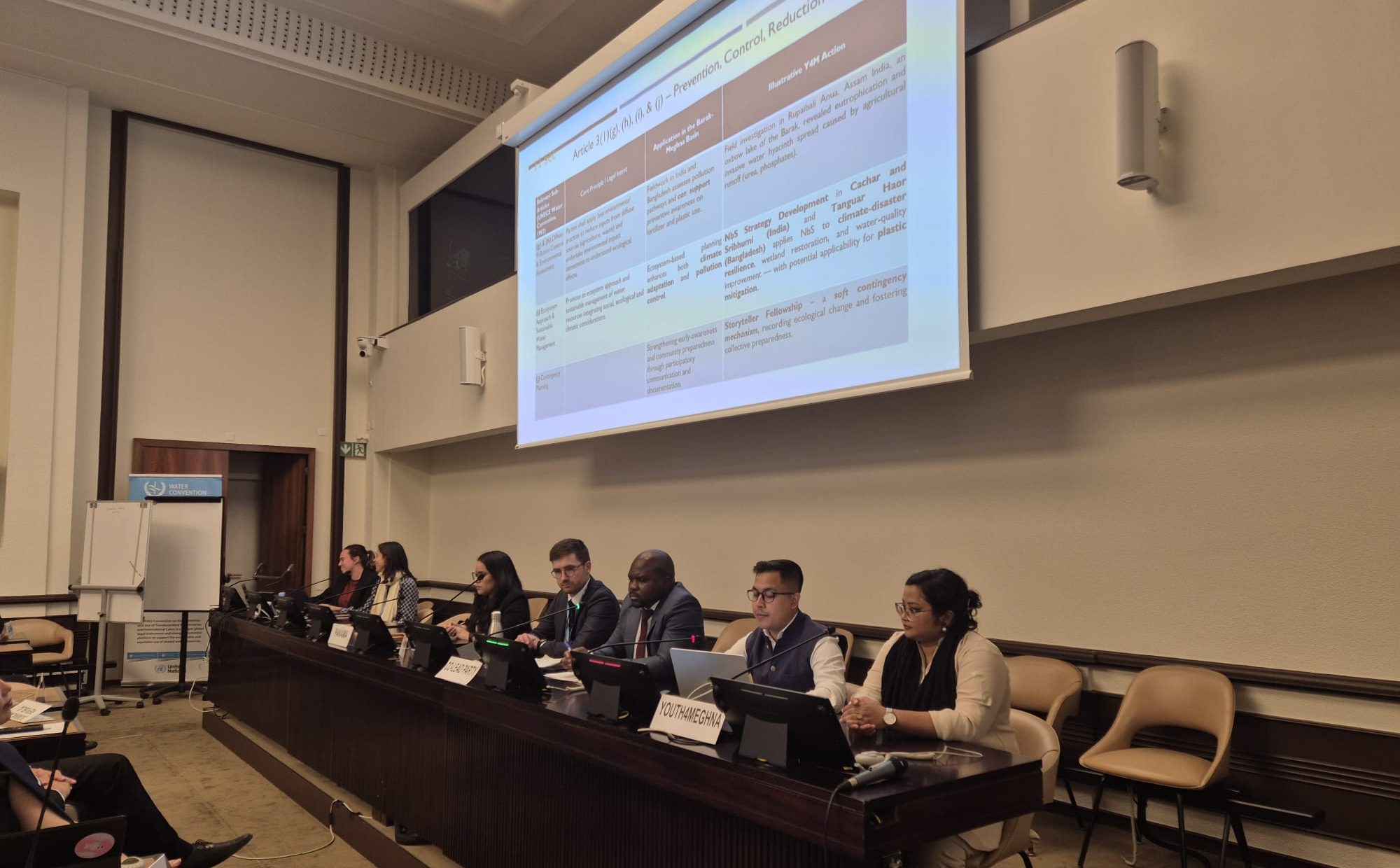
At the meeting we were invited to speak in a thematic session on the prevention and mitigation of plastic pollution in shared basin management.
Our presentation, titled “Youth for Pollution-Free Rivers: Applying Water Convention Principles in the Barak–Meghna Basin,” reflected on preliminary insights from our field study at Rupaibali Anua, an oxbow lake formed off the Barak River in Assam, India and in Tanguar Haor, a Ramsar wetland in Bangladesh, in May and June 2025 respectively.
In Rupaibali Anua, our study indicates that the lake is increasingly under strain from seasonal drying occurring much earlier in the year, causing reduction of the aquatic habitat. An inflow of wastewater and agricultural runoff from the lake’s surrounding settlements has also elevated nutrient loads which accelerates eutrophication, fuels rapid water hyacinth growth and lowers dissolved oxygen levels for aquatic life. Moreover, the silt deposition after rainfall diminishes the wetland’s water-holding capacity, further shrinking water capacity available for fishing.
Across the border in Tanguar Haor, our engagement with youth and community members reflects similar stressors playing out through daily life – plastic leakage accumulating within reed belts and fish-breeding pockets, shorter inundation cycles altering fishing seasons.
This is why cooperation across borders becomes essential, because rivers do not recognise boundaries. And it is here that the Convention on the Protection and Use of Transboundary Watercourses and International Lakes 1992, (Water Convention 1992) offers a framework for cooperation.
What Global Frameworks Can Offer Our Shared Basin?
Over the past decade, since 2014, the Water Convention has grown beyond its European origins, welcoming new Parties from across continents, today with 55 parties worldwide. Seeing countries like Bangladesh, which acceded to the Convention earlier this year, participating at the Working Group meetings, brought home a simple truth — what began as a regional agreement now belongs to the world, because water connects lives everywhere.
Because of this, we chose to view our work through the lens of the Convention, even though the Convention is yet to come into force across other countries in South Asia.
We believe that its principles — precaution under Article 2(5)(a), prevention and control of pollution under Article 3(1), and contingency planning under Article 3(1)(j), gives us a useful framework to think and act with, even before the Convention formally applies in our Basin. They help us look at early warning signs, support community resilience, and plan for change together, in a way that respects the shared nature of these waters.
At the UNECE Working Group in Geneva, we also presented how our workstream under the Barak-Meghna Storytellers Fellowship is a soft contingency, within Article 3(1)(j), which outlines preparing for environmental incidents before they escalate. These fellows joined us in October 2025, and are now working with Y4M to document local environmental change from their own locations, focusing on a range of themes. We hope to support small but timely observations that strengthen the everyday resilience of communities who feel environmental change first.
Additionally, Kishwar Jahan Chowdhury, joined the Women in Water Diplomacy Network (WWDN), a parallel dialogue organised by the UN University Institute for Water Environment and Health (UNU-INWEH). The event celebrated Bangladesh’s accession to the Water Convention and recognized women’s leadership as central to peaceful, cooperative transboundary water governance.
Our time in Geneva reaffirmed that local experiences could inform global frameworks and vice versa. The Water Convention provides a vital platform to translate scientific, legal, and civic understanding into shared responsibility.
Shared waters require shared responsibility. We remain committed to doing our part.
ABOUT THE AUTHORS
Joel B Kyndiah is a final year law student at the National University of Juridical Sciences (NUJS), Kolkata. He is a member of the Youth for Meghna (Y4M),
Kishwar Jahan Chowdhury is an Assistant Professor at the Institute of Forestry and Environmental Sciences, University of Chittagong. She is a member of the Youth for Meghna (Y4M).
